Description of Production Methods
First of all, it is important to clarify what is meant by filigree. It is a goldsmithing technique based on artisanal work, using extremely fine gold or silver wires, twisted two by two and flattened, applied to a previously defined and crafted framework/skeleton (also made of gold or silver).  The framework is the responsibility of the goldsmith, who shapes the piece and defines the area to be worked on and filled with wire. The meticulous work of filling the pieces with the fine twisted wires is carried out by the "fillers", usually (and traditionally, especially in Gondomar) women, who with delicacy, lightness, and patience, fill the frameworks according to the aesthetic dictated by the structure (framework).
The Repertory of Handicraft Activities, which classifies the activities in the arts and crafts sector and groups them into classes, defines the filigree technique as the "process aimed at obtaining extremely fine wires from a bar of gold or silver, which are then manually twisted, resulting in a serrated cord. The wire is bent, wound, and intertwined until the desired effect is achieved. There is application filigree (to decorate/fill other pieces) and integration filigree (a piece made entirely in filigree)."
In fact, filigree began as a technique applied to pre-existing jewelry, merely decorative, and gradually established itself as an individualized and aesthetically valued piece. There are, indeed, two currents that have accompanied filigree production over time: in an initial phase, up to the 19th century, filigree appears applied to jewelry pieces as an adornment or decoration of luxurious artifacts, often combined with gemstones, enamels, and other decorations. This is the application technique, where filigree did not play the main role, being applied to pre-existing jewelry, contributing to their decoration and aesthetic value.
 From the second quarter of the 19th century onwards, filigree is increasingly found as an integration technique, more complex and technically demanding, creating individualized pieces that stand on their own (on a framework, the filigree artist weaves the entire work with extremely fine and delicate wires).
We must mention excerpts from the work by Rocha Peixoto "As Filigranas" (1908), where the author so well explains all the phases of the traditional filigree manufacturing process, meticulously observed in the two main production centers in Portugal, Gondomar (S. Cosme) and Póvoa de Lanhoso (Travassos):
"To manufacture a piece of filigree, one usually starts by organizing its fundamental framework, with the large spaces defined by the structural ribs being intended to be adorned or filled with gold or silver wire, whose thinness and arrangement characterize this artistic specialty. The framework (...) is what, in Travassos, is called the 'armação', a ribbon of gold or silver obtained in what they call the cylinder, that is, between two parallel steel rollers, set in motion to achieve the desired thickness and width. (...)
Once the framework is built, the wire that will adorn and fill it is sufficiently thinned so that it can be bent and wound into spirals or SS and coils, as they say in Travassos, or 'crespos', as called in Gondomar. For obtaining the wire, the hammer is no longer used, though it is still remembered (...). It was replaced by the drawplate or 'damasquilho'. The drawplate is a thick steel plate perforated with holes of gradually decreasing sizes, through which the gold and silver are drawn to the thickness of an edge or even a hair. This operation is called pulling the gold (Travassos). To do this, the drawplate is placed between two parallel wooden blocks, firmly fixed at the end of a bench. The gold or silver, previously melted and cast into rods (S. Cosme), and rounded on an anvil, is brought to one of the drawplate's openings. The tip of the wire is made to emerge from it, and that tip is grabbed with a long pair of curved tongs, which hook onto the iron chain connected to the axle of a winch at the opposite end of the bench. As the wire passes through, it is then moved to the next smallest hole and so on until the required thinness is achieved.
This is how the goldsmiths of Travassos work. In Gondomar, however, they usually prefer the cylinder to the bench, then move the wire, as they do from the bench, to the tray, where, using a new attached drawplate with smaller holes, the filigree artist pulls the wire by hand with tongs. The wire is then brought to the thickness of an edge. Finally, from the tray, it goes to the 'carrinho', where, through the narrowest openings of the rubies, both metals reach their finest thinness. (...)
Usually, the single wire is not used. Two wires are taken, twisted by hand, the operation finishing between two boards, and the resulting cord is quickly annealed at the forge—also called annealing—binding the pair of wires, and then passed through the cylinder, which flattens them, turning them into a thin ribbon with subtle denticulation explained by the braiding. The wire twisted with another of equal thickness, appearing as a single engraved wire, is, and was in Antiquity, the principal element of filigree. (...)
The frameworks then remain to be filled (...). But first, the SS and the 'crespos' are organized (...). To bend and wind the SS wire (...), the 'buxela' (Travassos) is used, a kind of steel tweezer whose branches end in blades. On the iron tray, by forcing, holding, turning, and releasing the wire, the necessary curvature is gradually given, cutting it with one of the blades as soon as the S or spiral reaches the required size and winding. Still in Travassos, the 'buxela' was used to obtain the coils. In Gondomar (...), there is the 'ferro do crespo', a kind of plier whose ends unite in a cone. The gold wire is fixed at the tip of the tool, inserted into the 'embutideira'—a blade with small conical cavities—and the iron is given a rotational movement, more or less prolonged. Naturally, it winds around the iron; and since the cavity is shaped like a tiny inverted cone and the conical end of the iron fits into it, the resulting ornament is a tiny cone (...).
Once these rolls are obtained, the frameworks are finally filled. Once the piece or part of it is made, (...), it is placed on a charcoal or in a kind of umbrella mainly made of many iron wires, called 'piruca' in S. Cosme and 'aranhola' in Travassos. It is then covered with solder. And the blowtorch (...) now intervenes with its characteristic function. (...).
The supreme skill of the craftsman lies in the practice of such subtle soldering that it is not visible to the naked eye. (...)
In Travassos, half of the solder is made of gold, and the other half consists of one third copper and two thirds silver. In Gondomar, to 10 grams of gold, one and a half grams of silver and one and a half grams of copper and 'trincal' are added. The solder is sprinkled with the 'borrachinha' and, applying the blowtorch, the action of the fire is constantly watched. (...).
The gold filigree piece, once soldered, is annealed again to remove the effects of smoke and soldering. (...).
After cleaning, it still needs to be colored. (...).
(...) The filigree pieces, after being colored, are sanded or polished with fine sand, water, and a brush, to acquire their characteristic shine. (...) Once this is done, the objects are burnished, the last and simplest operation, which consists only of the skillful and, otherwise, brief friction with a cylindrical steel rod—the burnisher. (...)",
The production process described here is the traditional artisanal method of filigree production (although nowadays, and understandably, with some differences from what Rocha Peixoto described in the early 20th century). Today, some production phases have changed and been streamlined, either due to advances in equipment or because raw materials are already prepared and ready to use (wires), which does not alter the artisanal character of the activity.
However, we emphasize that the current filigree certification process will only cover artisanal filigree production, excluding any piece whose filigree is made by injection method, so present today in the market and responsible for the devaluation and trivialization of the term "filigree", confusing consumers and penalizing goldsmiths/filigree artists who see their product, the result of a complex and time-consuming manual process, compared with industrial and mass-produced pieces.
• Design
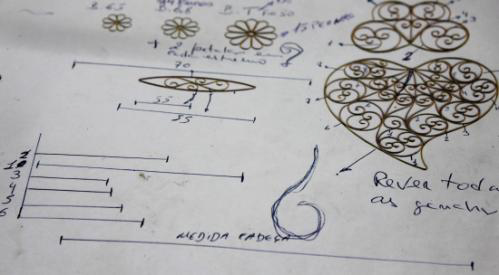 The starting point for creating a filigree piece is the design, usually made on a sheet of paper by the artisan or selected by them from a range of pre-existing design models, carefully kept in traditional workshops. It must be precise and clear, providing all necessary information for correct interpretation and transfer to metal. Most are freehand, intuitive drawings, the result of the artisan's observation and reproduction, or simple sketches without considering more complex and complete issues imposed by technical drawing. The drawing should follow a scale as close to real as possible, to avoid errors in transposing to the piece, through misinterpretations and projections that compromise the perfect representation of the drawn piece. Nowadays, due to the integration in some goldsmith workshops of designers responsible for creating more contemporary pieces, methods are changing and gradually being computerized. However, for more traditional pieces, the "old" sketches are still used, kept religiously by the goldsmith (or, not rarely, the images kept in the memory of older goldsmiths).
• Casting
 The metal (gold or silver) is placed in the crucible, which is heated in the forge to a temperature of about 900 degrees Celsius until it melts. The crucible is then removed with tongs and the metal poured into an iron mold, giving it the shape of a long bar. The sheet thus obtained is then hammered and drawn out into a blade. The model is transferred from the drawing to this sheet, which is then cut or sawed.
• Obtaining the Wire
 The wire obtained by casting and pouring into a mold is hammered on the anvil, and the first reduction in thickness is done with the wire-drawing bench. Once the desired dimensions are reached, it is shaped in the drawplate or "damasquilho" to a certain thickness and finally drawn through the so-called "rubis", tool pieces with a greater width than the drawplate, allowing for the production of wire with thicknesses less than 0.2mm.
• Twisting the Wire
 Two wires are taken and twisted by hand, finishing the operation between two boards. The resulting cord is then taken to the forge at about 700 degrees Celsius to be annealed, binding the two wires. These wires are then flattened by a cylinder, becoming lighter and laminated, and forming the twisted wire so important for achieving the final lacy result of the filigree.
• Obtaining the Skeleton, Framework or Structure
 The framework/skeleton defines and limits the spaces that will later be filled with wire. It is made from a gold or silver sheet/ribbon, obtained in the cylinder, which gives it the desired thickness and width, and in which the contour and interior ribs of the piece are formed to give it the required strength and appearance. The framework/skeleton can be made manually or using mechanical and technological means for its realization (injection, laser cutting, wax molds, among others).
• Filling the Piece
 Filling a piece means occupying the empty spaces of the framework/skeleton with the filigree wire. The wire that fills the pieces is twisted as previously described, flattened, and thinned so it can be wound into SS, spirals, and coils (Póvoa de Lanhoso) or "crespos" (Gondomar), scales, snails, shells, and cornucopias. To wind the wire, it is held in a tweezer or goldsmith's "buxela" (in Travassos), and with rotational movements, the cord is wound until the framework's gaps are closed. This process of filling the pieces, the true artistic work, is mainly carried out by women, whose lightness and agility of movement, combined with persistence and patience, make these works of finesse and lace possible.
• Soldering
 The piece is moistened in water or a kind of gum and the solder is poured over the piece (using the "borrachinha"). It is a difficult operation that requires much experience and skill to be executed properly. The filigree artist solders with a blowtorch (mouth blowtorch for gold works and forge for silver). The final goal of this task is to join the different components of the piece so that the solder is not visible.
• Shaping the Piece
 When the piece is made up of several components, it is necessary to group, assemble, and inlay them. This is done with a hammer, tweezers, and other tools, shaping the piece and giving it relief and a personalized touch.
• Finishing (bleaching, brushing, and drying)
 After being soldered, filigree pieces are oxidized and dirty, so they must be annealed again. To do this, several pieces are placed in a container and heated in the forge at high temperatures. After cooling, the pieces are bathed in a boiling solution of water and sulfuric acid, 3 or 4 times, until they take on the color of silver. The piece is scrubbed with a very fine metal brush with water and detergent until it shines, or it is polished in a ball machine or in a magnetic polishing machine. Finally, the piece goes into the dryer for drying.
Tools, Instruments, and Equipment Used
In addition to natural lighting (almost always present through large windows that illuminate the workshop) and the workshop furniture where the workbenches play the main role, with their drawers and compartments for storing small tools and collecting metal waste, the tools/instruments used by filigree artists are varied but simple. It should be noted that the list presented here refers to traditional equipment and tools, although some have been replaced by more effective and faster mechanical means, without losing the artisanal character of the production process (and not hindering the certification of the pieces produced).

Pliers – metal tool used for gripping (holding and pulling).

Scale – indispensable tool for weighing the different metals that make up the alloys.

Wire-drawing Bench - Long wooden bench used to stretch wire.

Anvil - Iron tool used for hammering sheet, finishing pieces, and riveting.

Borrachinha (Gondomar) or Cacifo (Póvoa de Lanhoso) – small cylindrical piece, with a lateral tube, used to distribute solder on the objects to be soldered.

Graver - Tool used to cut or engrave metals.

Crucible – small refractory clay container in which metal is melted and taken to the forge at high temperatures.

Oil and Gas Lamp - used to heat pieces for soldering or annealing with the help of the mouth blowtorch.

Wire-drawing Cart - Used with a drawplate or damasquilho to pull wire to the desired thickness.

Wire Cylinder – used to roll the wire: the wire passes through a laminator with overlapping grooves, forming holes of increasingly reduced diameter, where the wire thicknesses are adjusted.

Winder and Bobbin – wooden cylinder used to wind the wire.

Embutideira – wooden or steel piece, cubic or cylindrical, with several semi-spherical cavities of different sizes on the surfaces, used to give a concave shape to cut sheets.

Brushes - of various materials, adapted to different functions: cleaning pieces, brushing the table, collecting filings for the workbench drawer, burnishing pieces during finishing, etc.

Ferro de crespo or Coils Tool - a kind of pliers whose tips unite in a cone. The wire is fixed at the tip, inserted into the "embutideira" (blade with small conical cavities), and rotated. A tiny cone is obtained, whose surface results from the progressive bending of the wire.

Drawplate or Damasquilho – thick steel plate perforated with holes of decreasing sizes, through which the metal wire passes, reducing its gauge to the thickness of a hair (between 0.15 and 0.20 mm)

Forge – furnace used to soften metals so they can be melted and shaped while hot

Laminator – device made of two overlapping cylinders, through which the metal bar is passed and thus flattened into a thin sheet ("ribbon"). It can be manual (with a crank) or electric.

File – tool with a narrow, oblong iron or steel body, used to polish or smooth metals. They come in various sizes and shapes.

Gas Blowtorch – heat source used for soldering, heating, annealing pieces

Mouth Blowtorch – tube through which the filigree artist blows with their mouth to solder the piece. Placed between the lamp and the "piuca", the goldsmith controls the direction and amount of fire on the piece being worked.

Ball Machine – machine used for polishing pieces.

Hammer – T-shaped tool consisting of a wooden handle and a parallelepiped iron or steel blade, one end of which forms a point. Used for hammering, flattening, riveting, and nailing.


Goldsmith's Table or Bench – furniture consisting of several fundamental elements for goldsmith work (the top is a rectangular tray covered by a steel sheet; usually with three drawers—one for tools, another for work materials, and the top one to collect all filings left from filing, sawing, or cutting pieces). Generally placed near a window to take advantage of natural light or under an artificial lighting rail.

Tweezers or Buxela – small tongs used to work/wind the filigree wire during filling, hold small pieces, and assemble others. In Póvoa de Lanhoso, the buxela has the dual role of tweezers and cutter.

Refractory Plate – pressed sand plate used to support soldering, annealing, and enamel vitrification operations. In the past, the "piuca" or "aranhola" and also the "testo" (ceramic disk) were used.

Mold – iron or steel mold on which the goldsmith pours the molten alloy to produce sheet (for obtaining the framework) or wire.

Rubies – circular metal plates that support the ruby stone, with holes of very fine, variable thicknesses. It is the last stage of wire thinning.

Dryer – used to dry the piece

Saw or Hacksaw – cutting instrument with a toothed steel blade.

Tais or Tás – kind of anvil. Steel block with a flat surface, used by the goldsmith for working (hammering sheet, finishing, and riveting).

Tongs – metal tool (iron or steel) of various sizes, with two ends used for grabbing/holding pieces. There are several types of tongs depending on their function: casting tongs for removing crucibles from the forge, stretching tongs used at the wire bench, smaller tongs for gripping and bending wire.

Scissors – used by the fillers (from Gondomar) to cut the filigree wire. In Póvoa de Lanhoso, the cutting side of the buxela is the cutting tool used.
Source: Ramos, Graça, Caderno de Especificações para a certificação, 2017